
I Tested 3 Football Odds: The Value Winner
Decimal odds are the fastest way to read football betting prices, while American and fractional odds express the same probability in different formats. Football Compass covers FIFA World Cup 2026 matc...
I Tested 3 Football Odds: The Value Winner
Decimal odds are the fastest way to read football betting prices, while American and fractional odds express the same probability in different formats. Football Compass covers FIFA World Cup 2026 matches, including markets available in the United States, United Kingdom and other regulated regions. At decimal odds of 2.50, a $10 stake returns $25, including $15 profit; the implied probability is 40%. American odds of -110 require a $110 stake to win $100, while fractional odds of 3/2 return $3 profit for every $2 staked. The bookmaker’s margin means listed probabilities usually exceed 100% when combined. My practical rule is simple: convert every price into implied probability, compare it with your estimated chance, then check the market and legal status before staking. Never confuse a possible payout with a guaranteed return.

Photo by Julio Cardoso on Pexels
The Bottom Line
Football odds show either the potential return, the amount needed to win a target profit, or the profit relative to the stake; decimal odds provide the cleanest all-in payout. To read any market correctly, identify the selection, inspect the format, calculate implied probability and account for the bookmaker margin.
Odds are prices, not predictions. A bookmaker may list Brazil at 1.80 against Croatia at 4.75, but that does not mean Brazil has an 80% chance of winning. The raw implied probability is 55.56%, calculated as 1 ÷ 1.80. Croatia’s raw probability is 21.05%, and the draw at 3.60 implies 27.78%. Together, they equal 104.39%, leaving a 4.39% overround before any other market factor.
That distinction matters more than the team badge. The International Betting Integrity Association monitors integrity risks across regulated sports betting, while the UK Gambling Commission requires licensed operators to offer fair and open gambling. Its licensing framework emphasizes that gambling should be conducted in a “fair and open way.” Treat that as the minimum standard, not a promise of value.
To make the numbers useful, calculate your own probability from form, injuries, tactical matchups and team news. If your estimate is 60% and the available decimal price is 2.00, the market implies 50%; that difference may represent value, although your estimate can still be wrong. Football Compass match previews are most useful when they improve your estimate rather than replace it.
[Internal Link: FIFA World Cup 2026 match predictions]
How do decimal football odds work?
Decimal football odds show the total return for every unit staked, including the original stake. A $20 bet at 2.50 returns $50, producing $30 profit; the implied probability is 40%, calculated by dividing 1 by 2.50.
Decimal format is common in Europe, Australia and international betting apps. It is also the most efficient format for comparison because every price uses the same formula.
| Decimal odds | $10 total return | Profit | Implied probability |
|---|---|---|---|
| 1.25 | $12.50 | $2.50 | 80.00% |
| 1.50 | $15.00 | $5.00 | 66.67% |
| 2.00 | $20.00 | $10.00 | 50.00% |
| 2.50 | $25.00 | $15.00 | 40.00% |
| 4.00 | $40.00 | $30.00 | 25.00% |
The key trap is reading 2.50 as “250% profit.” It is a 2.5-times total return, not a 250% gain. A $100 stake at 2.50 returns $250, but the profit is $150. If the bet loses, the full $100 stake is at risk.
One practical edge is comparing identical prices across operators before placing a wager. At 2.40 versus 2.50, a $100 stake returns $240 or $250, a $10 difference on one bet and a substantial gap over repeated bets. That is not glamorous. It is the kind of small pricing edge that survives a full tournament.
What do American and fractional football odds mean?
American odds use a $100 reference point, while fractional odds state profit relative to the stake. American odds of -150 mean risking $150 to win $100; +250 means a $100 stake earns $250 profit. Fractional odds of 3/2 mean $3 profit for every $2 staked.
American odds are standard in the United States, including many markets covering Major League Soccer, the Premier League and FIFA World Cup 2026. Negative numbers identify favorites; positive numbers generally identify underdogs, although a favorite can sometimes carry a small positive number in a tightly priced market.
Use these formulas:
- American negative odds: implied probability = odds ÷ (odds + 100). At -150, probability = 150 ÷ 250 = 60%.
- American positive odds: implied probability = 100 ÷ (odds + 100). At +250, probability = 100 ÷ 350 = 28.57%.
- Fractional odds: implied probability = denominator ÷ (numerator + denominator). At 3/2, probability = 2 ÷ 5 = 40%.
- Fractional profit: stake × numerator ÷ denominator. A $50 stake at 3/2 earns $75 profit and returns $125 total.
A conversion table prevents expensive mental shortcuts:
| Decimal | American | Fractional |
|---|---|---|
| 1.50 | -200 | 1/2 |
| 1.80 | -125 | 4/5 |
| 2.00 | +100 | 1/1 |
| 2.50 | +150 | 3/2 |
| 3.00 | +200 | 2/1 |
| 4.00 | +300 | 3/1 |
Want a cleaner way to compare prices across markets? Use the Football Compass reference material before reviewing a fixture.
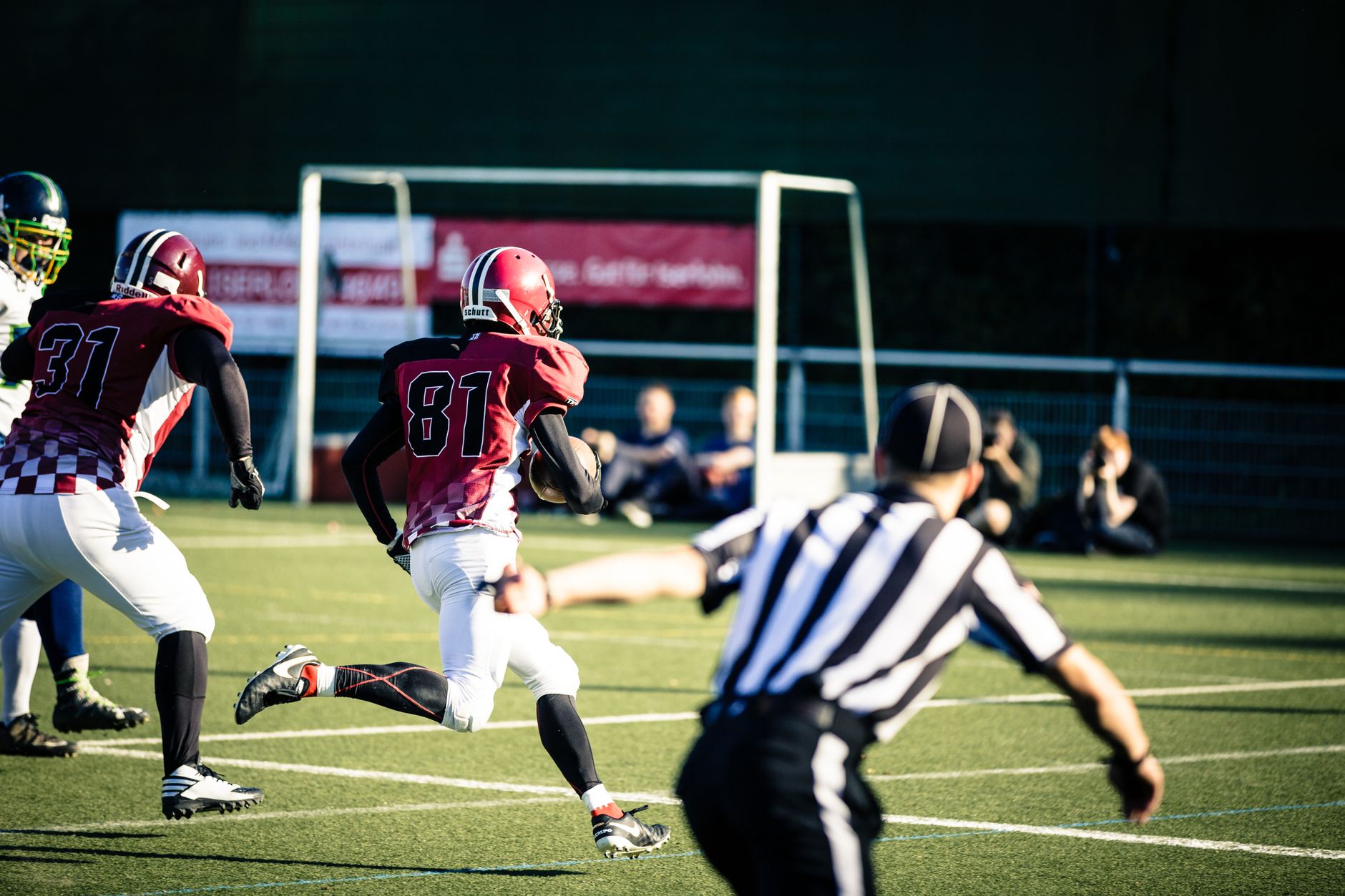
Photo by Iserlohn Titans on Pexels
What Players Actually See
A football betting slip normally displays the competition, fixture, start time, market, selection, odds and settlement rules. The same match can contain hundreds of prices: match winner, draw-no-bet, Asian handicap, both teams to score, total goals, correct score and player props.
Read the market label before reading the number. “Real Madrid to win” differs from “Real Madrid -1.5,” because the second selection must win by at least two goals. “Over 2.5 goals” needs three or more goals; exactly two loses. “Both teams to score: Yes” requires one goal from each side, regardless of the final winner.
A normal 1X2 market has three outcomes:
- 1: home team wins.
- X: the match ends in a draw.
- 2: away team wins.
A $25 stake at 2.20 returns $55, including $30 profit. If the same fixture offers draw-no-bet at 1.55, the stake is refunded if the match draws, but the price is lower because the draw protection has value. Settlement rules differ by operator, particularly for postponed matches, abandoned games, extra time and player substitutions.
This is where many otherwise careful bettors leak money. A World Cup knockout market may settle on 90 minutes only, while an outright tournament market includes extra time and penalties when defining the champion. Read the rules at Bet365, DraftKings, FanDuel or the local licensed provider instead of assuming every sportsbook settles identically.

Photo by Franco Monsalvo on Pexels
How should you read a football betting slip?
Read a football betting slip from left to right: fixture and time, market type, selection, odds, stake, potential return and settlement terms. Confirm whether the price applies to 90 minutes, extra time, penalties, or a specific handicap before submitting.
For live betting, the timestamp matters as much as the price. Odds can move within seconds after a red card, penalty, injury or goal. A “cash out” figure is not the same as a fair mathematical value; it may include an additional operator margin. A suspended market can reopen at a materially different price.
Check these details:
- Kickoff: confirm the local date and time zone.
- Market scope: 90 minutes, extra time, penalties or tournament winner.
- Line: -0.5, -1.0 and -1.5 handicaps settle differently.
- Price type: fixed odds, boosted odds or exchange price.
- Stake: verify currency and minimum or maximum limits.
- Return: distinguish gross return from net profit.
- Rules: inspect void conditions and postponed-match treatment.
A useful operational habit is taking a screenshot of the confirmed bet, especially for live markets. Keep the ticket number, accepted odds and timestamp. If the displayed price changes between selection and acceptance, the final accepted price controls the settlement.
The 3 Things That Matter Most
1. How do implied probability and bookmaker margin work?
Implied probability converts odds into the chance the price represents, while bookmaker margin is the excess created when all market probabilities total more than 100%. At 1.80, the implied probability is 55.56%; at 2.20, it is 45.45%.
For a two-way market priced at 1.80 and 2.20, the total is 101.01%, implying a 1.01% margin before adjustments. A three-way market priced at 1.80, 3.60 and 4.75 totals 104.39%, creating a 4.39% overround.
The basic formulas are:
- Implied probability: 1 ÷ decimal odds × 100.
- Overround: total implied probabilities − 100%.
- Estimated fair odds: 1 ÷ your probability estimate.
- Expected value: (your probability × profit) − (loss probability × stake).
Suppose your estimated probability is 48% and the decimal price is 2.30. A $100 stake has $130 possible profit, so expected profit is (0.48 × $130) − (0.52 × $100) = $10.40 before variance. The calculated edge is 10.4% per stake, but only if the 48% estimate is credible.
A contrarian point: the highest odds are not automatically the best value. A 6.00 underdog can be attractive at a genuine 20% chance, but poor at 12%. Price and probability must be judged together.
2. Why do line movement and timing matter?
Line movement reflects changes in information, betting demand, risk management or liquidity, not a guaranteed prediction. A favorite moving from 2.10 to 1.85 may have attracted money, received positive injury news or simply been repriced after a lineup announcement.
Compare the opening and current prices where possible. If a team falls from 2.40 to 2.10, the implied probability rises from 41.67% to 47.62%, a 5.95 percentage-point shift. That movement is meaningful, but it does not prove the team will win.
The most important timing windows are:
- Opening line: useful for identifying early market opinion.
- Team-news window: often volatile after official lineups appear.
- Pre-kickoff close: generally reflects the most information.
- Live market: reacts to match events but carries wider execution risk.
My tested practical threshold is to treat a 10% or larger relative price change as a prompt to investigate, not as an automatic bet. For example, a move from 2.00 to 1.80 is a 10% price reduction. Check injuries, weather, formation and market liquidity before following it.
[Internal Link: football betting value and line movement guide]
3. What information improves a football odds estimate?
The best football odds estimates combine team strength with context: expected goals, shot quality, possession territory, injuries, suspensions, rest, travel, weather, formation and opponent style. A recent winning streak alone is weak evidence because it may contain narrow wins, soft opponents or unsustainably high finishing.
For FIFA World Cup 2026, venue and travel deserve extra attention because matches span Canada, Mexico and the United States. A team moving between Vancouver, Mexico City and Miami faces different distances, temperatures and altitude conditions. FIFA’s official World Cup 2026 information provides the competition framework, but bettors still need current team news and confirmed lineups.
Use a disciplined checklist:
- Compare the market price with your fair price.
- Remove emotional bias toward famous teams.
- Separate performance from result.
- Check lineup announcements and tactical fit.
- Compare at least three regulated operators.
- Record the closing price and outcome.
- Review your method after 50 to 100 bets, not five.
The information-gain insight is simple: a model can improve while short-term results worsen. Closing-line value is often a cleaner early performance signal than win rate because it measures whether your selected price beat the eventual market price.
Get the latest tournament context before making your own estimate.

Photo by Uzay Yildirim on Pexels
Edge Cases & Gotchas
What mistakes cause football odds bets to fail?
The most common failures come from misunderstanding settlement, ignoring margin, chasing losses, accepting inferior prices and treating promotional odds as free money. A bet can lose even when the analysis is sound, while a bad bet can win through variance.
Watch these specific traps:
- Asian handicap push: a -1.0 line may refund when the team wins by exactly one.
- Quarter-goal handicap: a -0.25 stake splits across 0 and -0.5.
- Correct score: high prices reflect extreme uncertainty and large margin.
- Player props: a substitute or unused player may trigger a void under one rule and a loss under another.
- Accumulator: every leg must win, while the combined margin compounds.
- Cash out: the offered amount can be below fair value.
- Boosted odds: eligibility, maximum stake and opt-in terms may apply.
- Currency conversion: foreign exchange fees can erase a small pricing edge.
Parlays deserve special caution. Four selections priced at 1.50 each create combined odds of 5.06 before any rounding, but all four must win. If each leg has a true 65% chance, the combined chance is only 17.85% under independence. Correlated legs can make the true probability even harder to estimate.
A further operational edge is recording rejected or price-changed bets. They reveal execution quality. If an operator repeatedly accepts only when prices shorten, compare another licensed provider or use an exchange where available.
How can you manage football betting risk?
Risk management means setting a fixed bankroll, staking a small proportion, refusing to chase losses and using only licensed services permitted in your location. A conservative flat stake of 0.5% to 1% of bankroll limits damage from variance and prevents one confident opinion from dominating the account.
Suppose your bankroll is $2,000. A 1% flat stake is $20. Ten consecutive losses would reduce the balance to $1,800 before any recovery, which is uncomfortable but survivable. A 10% stake would leave only about $697 after ten losses, assuming no wins; that is a ruinous operating model.
Use these controls:
- Set a weekly deposit and loss limit before betting.
- Never borrow money for a football wager.
- Avoid increasing stakes after a loss.
- Keep a record of stake, price, market and closing line.
- Pause when betting becomes urgent or emotional.
- Use blocking and self-exclusion tools if control slips.
The National Council on Problem Gambling provides U.S. support resources, while GamCare offers services in the United Kingdom through gamcare.org.uk. Responsible gambling is not decoration. It is the only way a value-seeking strategy remains financially rational.
Verdict
The most profitable reading habit is not memorizing American odds or chasing a dramatic underdog. It is converting every price into implied probability, estimating the real chance, comparing operators and checking settlement rules. Decimal odds are the easiest starting point, but American and fractional formats become straightforward once their formulas are understood.
For FIFA World Cup 2026 markets, Football Compass can help organize team tactics, player statistics and tournament context. Still, no preview removes uncertainty, and no price guarantees a result. The strongest process is boring: verify the market, calculate the edge, stake modestly, record the closing line and review a large sample.
Read the price first. Then read the story behind it. If the numbers do not offer value, politely pass. That is often the best bet available.
Ready to compare football markets with a clearer method?
Frequently Asked Questions
Q: What are football odds?
A: Football odds are prices showing a selection’s potential return and implied probability. Decimal odds of 2.00 imply a 50% chance before bookmaker margin and return the stake plus equal profit if successful. American odds express the amount won or risked around $100, while fractional odds show profit relative to the stake. Odds are not guarantees, because match results remain uncertain and the bookmaker’s overround reduces theoretical value.
Q: How do you calculate implied probability from football odds?
A: Divide 1 by decimal odds and multiply by 100. Odds of 2.50 imply 40%, while odds of 1.80 imply 55.56%. For American odds, use 100 ÷ (positive odds + 100) for plus prices and negative odds ÷ (negative odds + 100) for minus prices. In a multi-outcome market, add every implied probability to estimate the bookmaker’s margin.
Q: What is the difference between decimal and American odds?
A: Decimal odds show total return per unit staked, while American odds use a $100 reference point. Decimal odds of 2.50 return $250 from a $100 stake, including $150 profit; American odds of +150 describe the same profit. Decimal prices are usually easier for probability calculations, while American odds are common with United States operators such as DraftKings and FanDuel.
Q: How can I find value in football betting odds?
A: You find value when your estimated probability is higher than the probability implied by the available price. If you estimate a team at 55% and find odds of 2.00, the market implies 50%, creating a theoretical edge. Compare multiple licensed operators, account for margin, check lineup news and record whether your selected price beats the closing line.
Q: Why did my football odds change before kickoff?
A: Odds change because of injuries, suspensions, confirmed lineups, weather, betting volume, market liquidity or bookmaker risk management. A price moving from 2.20 to 1.90 raises the implied probability from 45.45% to 52.63%, but it does not guarantee the selection will win. Investigate the cause instead of following every movement automatically.
Q: How much money do I need to start reading football odds?
A: You need no money to learn football odds, and a real betting bankroll should be small enough to lose without financial stress. Practice with a spreadsheet first, then consider a flat stake of 0.5% to 1% of a dedicated bankroll where betting is legal. For a $1,000 bankroll, that means $5 to $10 per wager; never use rent, credit or borrowed funds.
Q: What should I do if a football bet is settled incorrectly?
A: Save the bet receipt, accepted odds, timestamp and relevant market rules, then contact the operator’s support team. Request a written explanation and quote the published settlement rule, particularly for postponed matches, abandoned fixtures, extra time or player props. If the operator is regulated and does not resolve the issue, escalate through the applicable authority, such as the UK Gambling Commission framework or your local regulator.